
Morton’s Neuroma
What is a Morton’s Neuroma?
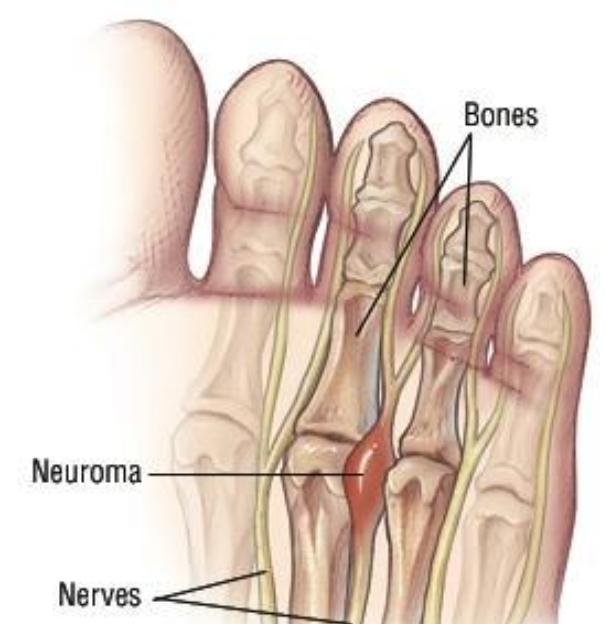
A Morton’s Neuroma is a painful condition affecting one of the nerves in the forefoot, most commonly between the third and fourth toes. It happens when the nerve becomes irritated and thickened due to repeated pressure or compression, which can lead to intermittent foot pain that often flares up during walking.
Many people describe it as a sharp, burning sensation in the ball of the foot, sometimes with tingling or numbness that can travel into the toes. It can genuinely stop you in your tracks and is one of the few foot problems that makes people instinctively take their shoes off for relief.
Common symptoms of Morton’s Neuroma
- Intermittent pain in the ball of the foot, especially when walking or standing
- A burning, stabbing or shooting sensation between the toes
- Tingling, numbness or a “pins and needles” feeling in the toes
- Feeling like you are “walking on a pebble” or there is a lump in your shoe
- Symptoms that worsen in tight footwear or high heels, and improve when shoes are removed

What is a Morton’s Neuroma?
A Morton’s Neuroma is a painful condition affecting one of the nerves in the forefoot, most commonly between the third and fourth toes. It happens when the nerve becomes irritated and thickened due to repeated pressure or compression, which can lead to intermittent foot pain that often flares up during walking.
Many people describe it as a sharp, burning sensation in the ball of the foot, sometimes with tingling or numbness that can travel into the toes. It can genuinely stop you in your tracks and is one of the few foot problems that makes people instinctively take their shoes off for relief.
Common symptoms of Morton’s Neuroma
- Intermittent pain in the ball of the foot, especially when walking or standing
- A burning, stabbing or shooting sensation between the toes
- Tingling, numbness or a “pins and needles” feeling in the toes
- Feeling like you are “walking on a pebble” or there is a lump in your shoe
- Symptoms that worsen in tight footwear or high heels, and improve when shoes are removed
A patient’s story
“I have had a very strange pain in my foot that no one seems to be able to diagnose. The problem is whenever I see somebody the pain seems to have gone. The pain only really occurs when I am walking, but it is never predictable. One day I can be in agony the next, whilst doing exactly the same things, perfectly pain free.
It is really hard to say where the pain is, but it is somewhere around my toes and the ball of my foot. Do you know what? I have even had to take my shoe off in the middle of the supermarket and wiggle my toes, which gives me some relief for a short time.
When I get home and look at my foot it is entirely normal and I cannot reproduce the pain by pressing on the spot where I think it was.”
Diagnosing Morton’s Neuroma
Morton’s Neuroma can be tricky because symptoms often come and go. At Total Foot Health, diagnosis starts with a detailed assessment of your symptoms, footwear, activity levels and foot mechanics. We will look for signs such as localised tenderness in the forefoot, altered sensation in the toes, and pain patterns that match a compressed nerve.
In some cases, imaging may be helpful. Ultrasound can sometimes be used to confirm the diagnosis and may also support treatment planning. The goal is to identify not only the neuroma itself, but also why the nerve is being irritated in the first place.
If you have ongoing forefoot pain, you may also find our biomechanics assessment page helpful, as foot mechanics and loading patterns often play a key role.
Why have I developed a Morton’s Neuroma?
A Morton’s Neuroma develops as a result of repeated compression and irritation of the nerve. This is often influenced by the way your foot functions during walking and standing, as well as external factors such as footwear and activity levels.
Common causes and risk factors
- Tight or narrow footwear that compresses the forefoot
- High heels that increase pressure on the ball of the foot
- Foot mechanics that overload the forefoot (for example, excessive pronation)
- High-impact or repetitive activities
- Structural changes such as bunions or toe deformities that alter pressure distribution
Because bunions can change the way weight is transferred through the forefoot, they are commonly associated with neuroma symptoms. Understanding the underlying cause is essential for long-term relief.
[Insert diagram showing Morton’s Neuroma here]
How do you treat a Morton’s Neuroma?
Treatment depends on what is causing the nerve irritation. The aim is to reduce pressure on the nerve, calm inflammation and improve how the forefoot is loaded during walking. In many cases, symptoms can be significantly improved without surgery.
Common treatment options
- Footwear advice to reduce compression and improve comfort
- Orthotics to offload pressure from the affected area and improve foot mechanics
- Padding or modifications to reduce nerve irritation during walking
- Steroid injection under ultrasound guidance where appropriate to reduce inflammation and pain
You can learn more about support options on our orthotics page, or read about injection under ultrasound guidance if an injection is recommended for you.
With the right plan, most people experience meaningful relief from discomfort and can return to everyday walking and the activities they enjoy with far more confidence.
Frequently Asked Questions about Morton’s Neuroma
What is a Morton’s Neuroma?
A Morton’s Neuroma is a thickening or enlargement of a nerve in the forefoot, often between the third and fourth toes. It causes sharp, burning, or electric pain when compressed.
What does it feel like?
Pain is often described as sudden, sharp, or burning in the ball of the foot or between the toes — sometimes forcing people to remove their shoes for relief. It may come and go unpredictably.
Why does Morton’s Neuroma occur?
It develops due to irritation or compression of a nerve, often caused by poor footwear, foot deformities like bunions, or biomechanical stress.
Can it be diagnosed if symptoms aren’t present during the appointment?
Yes. We use your clinical history, symptom patterns, physical examination, and diagnostic tools to confirm the condition — even if the pain isn’t active at the time.
How is it treated?
Treatment may include orthotics, footwear changes, and ultrasound-guided steroid injections to reduce inflammation and relieve nerve pressure.
Will I need surgery?
In most cases, Morton’s Neuroma can be successfully managed without surgery. We aim for non-invasive treatments first to avoid more drastic measures.
Can I still be active?
Yes — that’s the goal. By addressing the root cause, we aim to relieve symptoms and help you return to walking, exercising, or simply enjoying life without unpredictable pain.
Morton’s Neuroma Treatment Comparison
| Treatment Option | Home Remedies | Over-the-Counter Insoles | Podiatrist Care (TFH) |
|---|---|---|---|
| Rest and shoe changes | ✔ | ✔ | ✔ |
| Accurate diagnosis of nerve compression | ✘ | ✘ | ✔ |
| Custom orthotics to reduce pressure | ✘ | Limited | ✔ |
| Ultrasound-guided steroid injection | ✘ | ✘ | ✔ |
| Prevention of recurrence | Unlikely | Possible | ✔ |
| Ability to stay active long-term | Limited | Moderate | ✔ |
BOOK ONLINE